



Just about a year into her Penn State experience, second-year geosciences student Grace Druschel felt she already was making strides toward her research goals. Better yet, she was working on something she believes has extreme societal importance.
Content Administrator
Just about a year into her Penn State experience, second-year geosciences student Grace Druschel felt she already was making strides toward her research goals. Better yet, she was working on something she believes has extreme societal importance.
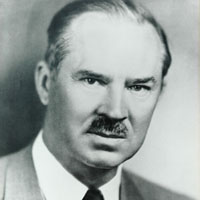 The Nelson W. Taylor Lecture in Materials Science and Engineering honors the memory of Professor Nelson W. Taylor (1869–1965) who was head of Penn State’s Department of Ceramics from 1933–1943. During his tenure as department head, Dr. Taylor refined the ceramics undergraduate curriculum, strengthened the graduate program, expanded ties with industry, and was able to attract important scientists (for example Woldemar A. Weyl) to the faculty. He is recognized as the individual most responsible for establishing the College of Earth and Mineral Sciences as a major center for ceramics research. The Nelson W. Taylor Lecture Series was established in 1969, and has consistently attracted scientists of international prominence.

A new form of a heterostructure of layered two-dimensional (2D) materials may enable quantum computing to overcome key barriers to its widespread application, according to an international team of researchers.

Advances in computing power over the decades have come thanks in part to our ability to make smaller and smaller transistors, a building block of electronic devices, but we are nearing the limit of the silicon materials typically used. A new technique for creating 2D oxide materials may pave the way for future high-speed electronics, according to an international team of scientists.

The 15th annual Materials Visualization Competition (MVC15) is now accepting submissions. The deadline for submissions is March 15.
The event is an annual scientific and artistic visual competition sponsored by the Department of Materials Science and Engineering and the Materials Research Institute at Penn State.

The coming decades present a host of challenges for our built environments: a rising global population combined with increasing urbanization; crumbling infrastructure and dwindling resources to rebuild it; and the growing pressures of a changing climate, to name a few.

Six new Penn State faculty members have joined the Institutes of Energy and the Environment (IEE). The researchers represent four Penn State colleges: the College of Earth and Mineral Sciences; the College of Engineering; the College of Health and Human Development; and the College of Medicine.
The researchers in the College of Earth and Mineral Sciences are Ida Djenontin, Nutifafa Yao Doumon and Stephanie Law.

For Haley Sankey, assistant teaching professor of energy and sustainability policy, it was a teacher’s humor, patience and ability to empower that inspired her to become an educator. For Jim Adair, professor of materials science and engineering, it was the ability to put pressing civil rights events into context. For Ken Davis, professor of atmospheric and climate science, it was the teacher’s knack to challenge and demand excellence. Jesse Reimink, assistant professor of geosciences, learned the importance of geosciences and the value of communicating that passion.
MatSE is proud to acknowledge and celebrate this holiday celebrated in China, South Korea, Vietnam and more!
The Lunar New Year took place this year on Sun., January 22, 2023. It represents the start of the Spring season, as well as, a new year to begin on the lunisolar calendar, as described by The Smithsonian.
Click here to learn more about this holiday.