


 The Nelson W. Taylor Lecture Series in Materials Science and Engineering honors the memory of Professor Nelson W. Taylor (1869–1965) who was head of Penn State’s Department of Ceramics from 1933–1943. During his tenure as department head, Dr. Taylor refined the ceramics undergraduate curriculum, strengthened the graduate program, expanded ties with industry, and was able to attract important scientists (for example Woldemar A. Weyl) to the faculty. He is recognized as the individual most responsible for establishing the College of Earth and Mineral Sciences as a major center for ceramics research. The Nelson W. Taylor Lecture Series was established in 1969, and has consistently attracted scientists of international prominence.
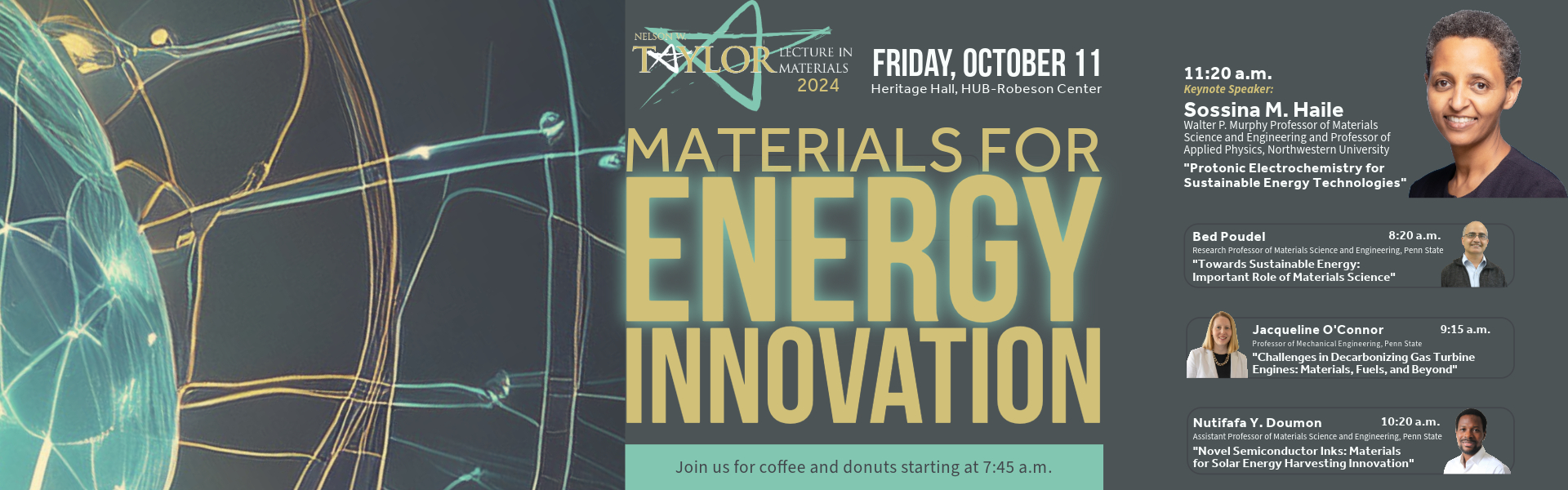
Join us on Friday, October 11 for the 2024 Taylor Lecture
7:45 a.m. - Coffee and donuts
8:20 a.m. - "Towards Sustainable Energy: Important Role of Materials Science" presented by Bed Poudel, Research Professor of Materials Science and Engineering, Penn State
9:15 a.m. - “Challenges in Decarbonizing Gas Turbine Engines: Materials, Fuels, and Beyond” presented by Jacqueline O'Connor, Professor of Mechanical Engineering, Penn State
10:20 a.m. - "Novel Semiconductor Inks: Materials for Solar Energy Harvesting Innovation" presented by Nutifafa Y. Doumon, Assistant Professor of Materials Science and Engineering, Penn State
11:20 a.m. - Keynote: "Protonic Electrochemistry for Sustainable Energy Technologies" presented by Sossina M. Haile, Walter P. Murphy Professor of Materials Science and Engineering and Professor of Applied Physics, Northwestern University
2024 Keynote Speaker
"Protonic Electrochemistry for Sustainable Energy Technologies"
Sossina M. Haile, Walter P. Murphy Professor of Materials Science and Engineering and Professor of Applied Physics, Northwestern University
Over the past decade, the costs of solar and wind electricity have plummeted, declining by about 90%. The challenge in achieving sustainable energy goals thus no longer lies in creating electricity technologies with negligible carbon footprint, but instead in creating methods for storing the electricity for use when the sun isn’t shining or the wind isn’t blowing. Electrolysis of water, or using electricity to split the H2O molecule into hydrogen and oxygen, has garnered renewed interest due to the suitability of hydrogen for long term energy storage. Subsequent use of that hydrogen in fuel cells generates electricity without carbon emissions. Here we describe recent advances in electrochemical cells that can operate reversibly to both generate hydrogen from electricity and generate electricity from hydrogen, effectively functioning like rechargeable batteries. These devices employ proton conducting ceramic electrolytes suitable for operation at 500-700 °C, considered an ideal temperature range for a myriad of reasons. While reversible operation of protonic ceramic electrochemical cells in localized settings can address storage for the electrical power grid, the use of hydrogen in automotive and other applications has been hindered by the lack of a hydrogen delivery infrastructure. One solution that is gaining momentum is the use of ammonia as a carbon-free, easily liquified carrier of hydrogen. Success in this approach relies on local conversion of the ammonia into nitrogen and ultra-high purity hydrogen that can be supplied to polymer exchange membrane fuel cells. We describe recent progress in the use of electrochemical devices based on superprotonic solid acid electrolytes for electrochemical conversion of ammonia to ultrahigh purity hydrogen. The overview of these technologies will focus on the fundamental materials limitations and the steps undertaken to overcome them so as to achieve devices with compelling performance metrics.
Sossina M. Haile is the Walter P. Murphy Professor of Materials Science and Engineering at Northwestern University, a position she assumed in 2015 after serving 18 years on the faculty at the California Institute of Technology. She earned her Ph.D. in Materials Science and Engineering from the Massachusetts Institute of Technology in 1992.
Haile’s research broadly encompasses materials for sustainable electrochemical energy technologies. Her work in fuel cell science and technology has pushed the field to new insights and record performance metrics. In parallel, she has created new avenues for harnessing sunlight to meet rising energy demands and demonstrated viable solutions to the challenge of hydrogen delivery.
Amongst her many awards, in 2008 Haile received an American Competitiveness and Innovation (ACI) Fellowship from the U.S. National Science Foundation in recognition of “her timely and transformative research in the energy field and her dedication to inclusive mentoring, education and outreach across many levels.” In 2010 she was the recipient of the Chemical Pioneer Award (American Institute of Chemists), in 2012 the International Ceramics Prize (World Academy of Ceramics), and in 2020 the Turnbull Lectureship (Materials Research Society). She is a fellow of the Materials Research Society, the American Ceramics Society, the Electrochemical Society, the Royal Society of Chemistry, the African Academy of Sciences, and the Ethiopian Academy of Sciences, and serves on the editorial boards of Joule and MRS Energy and Sustainability. Haile also currently serves on the DOE Basic Energy Sciences Advisory Board and on the board of the non-profit Ethiopia Education Initiatives.
"Towards Sustainable Energy: Important Role of Materials Science"
Bed Poudel, Research Professor of Materials Science and Engineering, Penn State
Electrical Energy has transformed the human civilization and has brought many technological advances and comforts to human beings. Meantime, the energy generation has left damaging footprints to the environment we live in. Developing more efficient energy generation technologies and/or returning to renewables to help mitigate climate change is an excellent approach which needs to be sustainable in order to meet energy demand of future generations. In this lecture, I will discuss how research in materials science can play a critical role in the advancement of renewable energy technologies and contribute to the mitigation of environmental problems. I will mainly focus on Thermoelectric and Solar energy technologies as model examples.
Bed Poudel, Ph.D., is Research Professor in the Department of Materials Science and Engineering and an Intercollege Graduate Degree Program (IGDP) faculty member at Penn State. He also serves as an associate director of an NSF-IUCRC center at Penn State University called "Center for Energy Harvesting Materials and System (CEHMS)". He holds a Ph.D. degree in Physics from Boston College and a master's degree from Tribhuvan University, Nepal, and has more than twenty years of experience in sustainable energy materials research and product development.
He is considered a pioneer in the field of nanostructured thermoelectric materials has expertise in various energy generation technologies such as solar, thermoelectric, piezoelectric, magnetoelectric, etc. He holds over twenty patents and patents pending in the field of renewable energies and has published over seventy-five scientific articles in various journals including Science and Nature Materials. He is also a recipient of R&D 100 award in 2008.
Prior to current role, Dr. Poudel worked in several renewable energy companies utilizing advances in nanotechnology. At Nimbus Materials Inc, he worked as a R&D director developing flexible-thin film thermoelectric products for body powered thermoelectric generators for consumer electronics and sensors. Earlier, as a director of R&D and CTO at Evident Technologies, he led the technical team in developing high temperature thermoelectric materials and devices and launching thermoelectric generator products. Dr. Poudel also worked at GMZ Energy in various roles including R&D director from 2007 to 2013 developing thermoelectric materials and solar generator products.
“Challenges in Decarbonizing Gas Turbine Engines: Materials, Fuels, and Beyond”
Jacqueline O'Connor, Professor of Mechanical Engineering, Penn State
In an effort to achieve worldwide decarbonization goals, a range of low-carbon fuels is being proposed for use in gas turbine engines, including aviation, marine, and power-generation variants. These technologies are critical to economic growth, national security, and global connectivity. Several promising fuels have been proposed to lower climate impact, including hydrogen, ammonia, and renewable liquid fuels. While the use cases of these fuels differ, each has the potential to reduce the carbon intensity of power generation as compared to the current use of natural gas and fuel oil. Many studies have considered the impact that these fuels will have on combustion stability and emissions, as well as other practical considerations like balance of plant. However, potential challenges for the material systems in these engines, particularly high-temperature metal alloys and coatings, have not been sufficiently considered in preparation for the introduction of these fuels. This talk will provide a review of the potential material issues associated with implementation of these low-carbon fuels, with a focus on materials in the hot section of gas turbine engines. To date, relatively little research has considered these material issues at realistic gas turbine conditions, resulting in a need for new research. This talk will provide a review of the literature, first-order analyses of the magnitude of potential issues, and avenues for research to facilitate the safe and reliable introduction of these fuels in gas turbine technologies.
Jacqueline O'Connor is a professor of mechanical engineering and an associate director of the Climate Consortium at the Penn State. Her research group, the Reacting Flow Dynamics Laboratory, focuses on issues related to combustor operability, alternative fuels, and material durability in hard-to-decarbonize sectors like aviation, marine, and industrial processes. She received a BS from MIT in Aeronautics and an MS and PhD from Georgia Tech in Aerospace Engineering. Before coming to Penn State, she served as a post-doctoral researcher at the Combustion Research Facility at Sandia National Laboratories. She is a fellow of the American Society of Mechanical Engineers and an associate fellow of the American Institute of Aeronautics and Astronautics.
"Novel Semiconductor Inks: Materials for Solar Energy Harvesting Innovation"
Nutifafa Y. Doumon, Assistant Professor of Materials Science and Engineering, Penn State
Energy is core to human activity and development. Solar energy from traditionally established technologies, such as Si photovoltaics (PV), has played a crucial role in the energy mix for decades: they are resilient and offer about 25 years of service. Organic and perovskite PVs are emerging solar technologies with great promise as alternatives to Si PVs. With direct implications for the future of solar power, especially in urban cities with high-rise buildings, they seek to move toward a new paradigm that focuses on decentralizing solar energy and making solar panels accessible, flexible, and end-user-friendly. The new materials for PVs are lightweight, ultra-thin, and (semi)transparent, offering room for a high power-to-weight ratio compared to Si panels. However, they suffer from toxicity and severe degradation, leading to low long-term stability and lifetime. These challenges for organic and perovskite PVs are highlighted, and efforts to understand or mitigate them are discussed.
Nutifafa Y. Doumon is an assistant professor of Materials Science and Engineering at Penn State. He is a Virginia S. and Philip L. Walker Jr. professor of Materials Science and Engineering and the Fuels Science Program. Before joining Penn State, he worked as a researcher at the National Renewable Energy Laboratory (NREL) in Golden, Colorado, and INRS-EMT in Varennes, Canada. He holds a Ph.D. in Applied Physics and an M.Sc. in Nanoscience from the University of Groningen, the Netherlands. In 2011, he obtained an M.Sc. degree in Theoretical Physics from AUST-Abuja after a B.Sc. degree in Physics in 2009 from the University of Ghana, Legon. His research interests are organic, polymer, and perovskite photovoltaic and optoelectronic device characterization, stability, and reliability testing.
Nelson W. Taylor Awardees
* Nobel Laureate
| 2023 Arun Varshneya 2022 Michael Rubinstein 2020 Cato T. Laurencin 2019 Giulia Galli 2018 Ramamoorthy Ramesh 2017 Jennifer Lewis 2016 Shuji Nakamura* 2015 Thomas Kelly 2013 P. M. Ajayan 2012 Subra Suresh 2010 Chad A. Mirkin 2009 Tobin J. Marks 2008 John B. Goodenough* 2007 Timothy P. Lodge 2006 Lawrence L. Kazmerski 2005 Marvin L. Cohen | 2004 Robert S. Langer 2003 Charles M. Lieber 2001 George Craford 1999 John Price Hirth 1998 Alan G. MacDiarmid* 1997 Larry L. Hench 1995 Thomas W. Eagar 1994 Gerhard Wagner 1993 Richard E. Smalley* 1991 Richard Balzhiser 1990 Mats Hillert 1989 Sir Samual Edwards 1988 Makoto Kikuchi 1987 David W. Johnson, Jr. 1986 Paul B. Weisz 1985 Julian Szekely | 1984 Pierre-Gilles de Gennes* 1983 William O. Baker 1982 W. Dave Kingery 1981 Irving Wender 1980 Morris Cohen 1979 Turner Alfrey, Jr. 1978 Edward Teller 1977 Elburt E. Osborn 1976 John A. Duffie 1975 Cyril Smith 1974 Herman Mark 1973 Linus Pauling* 1972 Gene Haertling 1971 Clarence Zener 1970 John Saylor 1970 Horst Scholze |