


Thank you for your interst in the Department of Materials Science and Engineering! We’re excited to help you in exploring majors and career paths. To receive more information about your particular interests and opportunities for undergraduate students in Penn State's Department of Materials Science and Engineering, please fill out and submit the form below. We will send you materials in the mail soon.
Content Administrator
Welcome to Penn State MatSE!
Our highly-ranked, close-knit, and inclusive program is passionate about materials and the impact they have on the world. The MatSE family includes students, faculty, staff, researchers, alumni, industry partners—and you.
Studying materials science and engineering provides excellent skills for a wide range of jobs in research and industry. People who can create and improve already existing materials are needed in almost every industry. Our top priority is educating you to secure a meaningful, impactful career after graduation, and we look forward to supporting you along the way.
In MatSE, we take an interdisciplinary approach to our research, and we are solving problems that impact the world. We invest in our interdisciplinary research and believe in a strong collaborative culture across disciplines.
Our researchers have the support of both academic departments and university-wide institutes. By encouraging crosscutting research to open-up traditional silos of knowledge to the stimulus of other viewpoints and new ideas. This mingling of disciplines often called “convergence,” brings together the physical and life sciences with engineering and computation to solve the most complex problems facing society today and in the future.
Materials science is growing in so many areas that we can’t predict the future of the field—it’s wide open—and very exhilarating.
At Penn State, we offer the Intercollege Graduate Degree Program (IGDP) in Materials Science and Engineering (MatSE). Grounded by strong research and education, the IGDP encompasses the entire spectrum of materials, including inorganic and structural materials, electronic and photonic materials, polymers and biomaterials, and computational materials science. 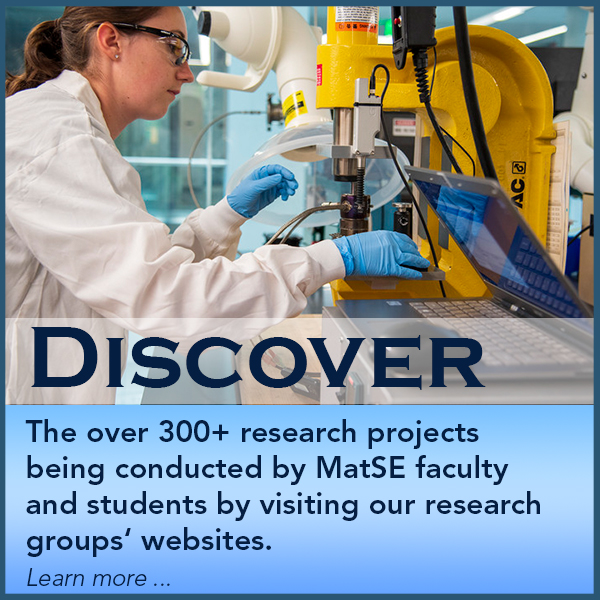
Through a combination of MatSE courses and a wealth of materials-related courses in the science and engineering departments at Penn State, students choose to study across the major themes of materials today. Working with IGDP faculty, students participate in research beyond MatSE including other departments within the College of Earth and Mineral Sciences, the College of Engineering, the Eberly College of Science, the College of Agricultural Sciences, the Applied Research Laboratories, and other Penn State entities.
Our graduate students are studying materials in energy applications, nanotechnology, materials in medicine, materials in communications, materials for sensor applications, structural materials—just to name a few. Visit some of our research groups websites to see the amazing discoveries happening in the MatSE IGDP.
It’s an exciting time to be a part of the IGDP in MatSE! Learn more about applying .
Empower Your Future
Join a globally recognized program, consistently ranked among the nation’s best in materials science and engineering. You'll gain exceptional skills that open doors to diverse career opportunities in both research and industry.
Pursue your passions in a collaborative culture that values shared success, all within an academic community dedicated to guiding and supporting you every step of the way.
When you graduate, you'll become part of a global network of Penn Staters, ready to offer a lifetime of opportunities, support, and community—grounded in the shared experience of one of the world’s leading universities.
Materials engineers create and study materials at the atomic level. They study the scientific principles behind materials, focusing on structure, properties, and processing to create real-world applications. They apply core concepts from chemistry and physics to understand, improve, and design materials for specific purposes.
Materials engineers work with a variety of materials including metals, polymers, ceramics, composites, glass, nanomaterials, ferroelectrics, energy, semiconductor chips, and computational materials.
They use a variety of processes and discovery principles like casting, additive manufacturing (3D printing), coating, evaporation, plasma and radiation processing, artificial intelligence, and computer modeling.
Whether it is creating new materials that meet certain mechanical, electrical, and chemical requirements, helping select materials for specific products, or developing new ways to use existing materials—our graduates are in high demand in fields like aerospace, biomedical materials, plastics, semiconductor, sustainability, nuclear power, and alternative energy.
The Department of Materials Science and Engineering is part of the College of Earth and Mineral Sciences at Penn State. The college's Office of Marketing and Communications is committed to providing the news media with easy access to information about our cutting-edge research, faculty expertise, and college activities.
If you are a member of the media reporting on topics relating to Penn State's College of Earth and Mineral Sciences, please contact:
 Patricia Craig, Director of Marketing and Communications
116 Deike Building, University Park, PA 16802
Telephone: 814-863-4663
Email: plc103@psu.edu
The Department of Materials Science and Engineering produces print and electronic communications that showcase the activities and achievements of our faculty, alumni, students, alumni, donors, and partners.
Learn about the numerous resources and services provided by the Office of the Associate Dean for Research and Graduate Education and its Research Administration office; explore the college's open faculty positions; and view the variety of competitive awards in support of research, service, teaching, mentoring, and advising are presented annually to faculty within the College of Earth and Mineral Sciences.
The department is an international leader in materials education and research. As a top-ranked program, the department thrives on a rich collaboration between faculty, staff, students, and researchers to promote a well-rounded academic experience and innovative research opportunities. In addition, our highly ranked undergraduate degree program is accredited by the Accreditation Board for Engineering and Technology (ABET).