


Administrator

The Materials Visualization Competition (MVC) is an annual scientific and artistic visual competition sponsored by the Department of Materials Science and Engineering (MatSE) and the Materials Research Institute (MRI). Created to celebrate the quality of research in materials at Penn State, this competition increases awareness of materials science through the creativity and visualization of our researchers.
Visit the MVC website commemorating over 15 years of the MVC and the many beautiful, dramatic images of the competition.
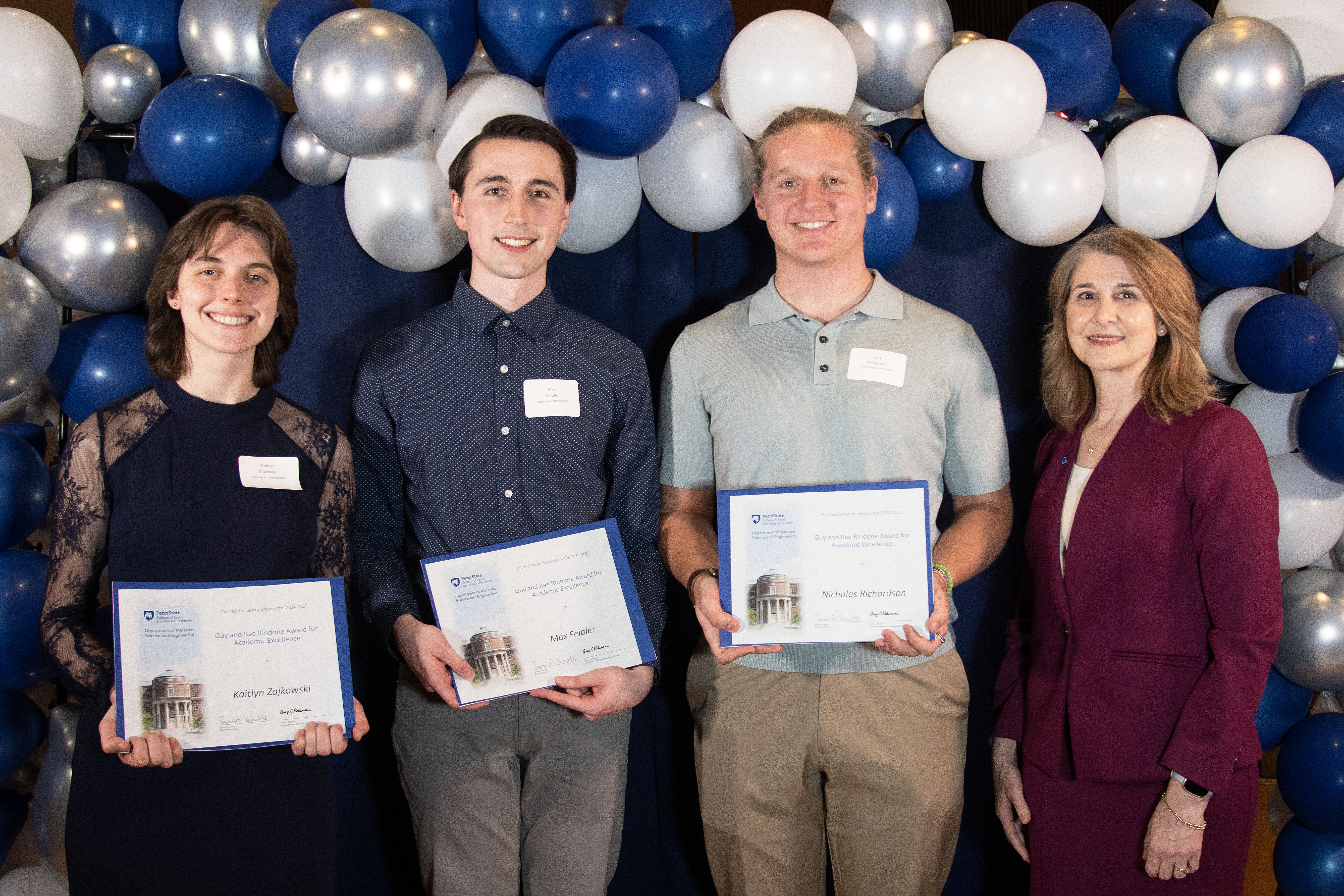
In the spring, MatSE students, faculty, staff, and alumni are honored at the annual MatSE Awards Presentation. During the event, we celebrate our collective achievements from the past year, and announce the following:
- Materials Visualization Competition (MVC)
- New awards, scholarships, program supports
- Undergraduate awards
- Undergraduate Research Poster Competition
- Graduate awards
- Graduate Research Poster Competition
- Safety Award
- Faculty of the Year Award
- Staff Member of the Year Award
- MatSE Alumnus or Alumna of the Year
MatSE has thirty-one tenure-line academic faculty members involved in all aspects of materials research. Our faculty frequently collaborate with investigators in other departments, other Penn State colleges, and other institutions as they seek scientific advances in research that will change the world.
Materials processing and synthesis refers to the fabrication or artifical production of materials and may involve processes such as solution-phase chemistry of nanocrystal/nanowire materials, synthesis of polymer materials by a range of controlled polymerization techniques; inorganic synthesis by chemical vapor deposition, physical vapor deposition, and atomic layer deposition and others. Materials synthesis often involves a diverse array of disciplines including chemistry, analysis and characterization, and computational analysis.
Materials scientists will play a critical role in how we utilize our finite resources to their fullest potential. Sustainability in the context of materials may refer to smarter battery technology that requires fewer materials, technology that allows the production of energy from waste material, organic LED's in which the emissive electroluminescent layer is a film of organic compound, or the devlopment of new sustainable materials and processes.
Along with metals and ceramics, the study of polymers has risen to become a cornerstone of materials science and engineering in recent years. Polymers have the potential to solve many of the world's most complex problems. Water purification, energy research, oil extraction and recovery, advanced coatings, myriad biomedical applications, building materials, and electrical applications - virtually no area of modern life would be possible without polymeric materials
Piezoelectric materials are certain solid materials (such as crystals, certain ceramics, and biological matter such as bone, DNA and various proteins) that convert mechanical pressure to electrical energy (and vice versa). Such materials are used in a wide range of devices including inkjet printers, speakers, watches and timing devices, actuators, sensors, and ultrasound imaging systems.
The overlap between physics and materials science has led to the offshoot field of materials physics, which is concerned with the physical properties of materials. New physics emerge because of the diverse new material properties that need to be explained. Researchers concerned with materials physics are critical to bridging the gap between developing new materials and their practical applications. Exploration of material physics may also involve some component of analysis and characterization or computational study.