


Administrator
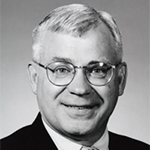 The Richard E. Tressler Lectures in Materials honors the very important work of Professor Richard E. Tressler who was head of Penn State's Department of Materials Science and Engineering from 1991-2001. During Professor Tressler's tenure as department head, he sought to enhance Penn State's reputation for excellence in materials by hiring over 15 new faculty members and by reorganizing the department from an option-focused organization into a global materials organization being emulated by the leading materials departments across the world. Professor Tressler retired as Professor Emeritus of Materials Science and Engineering in 2001 and received the Hosler Alumni Scholar Award from the College of Earth and Mineral Sciences as recognition for his contributions and accomplishments.
Traditionally in the spring semester two Tressler Lectures in Materials are held as part of the Distinguished Lecture Series presented by the Penn State Department of Materials Science and Engineering.

Penn State’s research expenditures exceeded the $1 billion mark in fiscal year 2019-20. The total figure, $1.01 billion, places Penn State among a select group of research universities nationally, and reflects the interdisciplinary strength built over three decades. It represents a $40 million increase over last year’s number, and includes a record $633 million in federal funding, as well as $375 million from a combination of private funders, the commonwealth of Pennsylvania and University sources.

The Center for Nanoscale Science, a National Science Foundation Materials Science and Engineering Center (MRSEC), has again successfully renewed its NSF support in the highly competitive MRSEC program. The new iteration of the center encompasses two of NSF’s Big Ideas — "Quantum Leap" and "Harnessing the Data Revolution."

For students, losing the opportunity to attend summer conferences due to the COVID-19 pandemic meant even fewer chances to advance their academic careers. Students typically have just a few years to attend, present their research, and find areas of interest they’d like to specialize in.

Eighteen students were named National Science Foundation (NSF) Graduate Research Fellowship Program (GRFP) recipients for the 2020-21 academic year. These 18 students join 65 prior recipients continuing in the University’s graduate degree programs through the Graduate School in the Eberly College of Science, College of Agricultural Sciences, College of Earth and Mineral Sciences, College of Engineering, College of Health and Human Development, and the College of the Liberal Arts, as well as, the Intercollege Graduate Degree Programs.

Bo Wang, who earned his doctorate in materials science and engineering from Penn State in August 2020, is the recipient of a Gold Graduate Student Award from the Materials Research Society (MRS). He was selected as one of the seven students to receive the Gold Award from a competitive international cohort of 19 finalists.

Adding noise to enhance a weak signal is a sensing phenomenon common in the animal world but unusual in manmade sensors. Now Penn State researchers have added a small amount of background noise to enhance very weak signals in a light source too dim to sense.